Showing posts with label reading. Show all posts

Tuesday, January 12, 2010

Misery and Maximizers

John Maeda made a brilliant observation in his TED talk about simplicity.  To paraphrase: people like complexity in things they enjoy, and they hate complexity in things they dislike.  Yes!  Complexity in music & books captivates me, complexity in my tax returns makes me want to jump in front of a train.

In 2010, I’ll be trying to reduce some of the unnecessary complexities in my life.  As an organization freak & computer lover with a subconscious lust for complex systems, this won’t be easy, but I think Maeda’s point provides excellent guidance.

I’m also getting some terrific input from a book called The Paradox of Choice by Barry Schwartz, a psychologist and professor at Swarthmore College.  The book aims to explain why a culture with greater freedom & variety than any other in history is causing people to be unhappier and less satisfied with their decisions.  In Chapter 4, Schwartz explains the difference between maximizers (those who must find the best possible choice for every decision) and satisficers (those who settle for good enough and don’t worry about the existence of better possibilities).  Guess which one correlates more strongly with less satisfaction with life, less happiness, less optimism, and more depression?  As a solid maximizer (as evaluated by the survey in the book), I wasn’t happy to learn the answer.

One recurring theme of the book: reducing the number of options often leads to greater satisfaction with a decision.  I think that’s something I can work with.

* * * * * * *

This week, the girl you see here turned 25.

You might think a 25-year-old should be more mature.  I blame her boyfriend for being a bad influence.

Monday, January 5, 2009

Externalizing my brainwaves

For starters, new blog with zee puppets.


* * * * * * *

It's a new year, folks!  Did you rock in 2008?  Did you suck?  Yes, you sucked?  Is it time to stop sucking so much?  There are a number of things I'd like to work on in 2009: regrowing an attention span, not being a jerk to my mom when she asks me computer questions (ugh, so bad at this... sorry, Ma), getting more sleep like I promise myself I'm going to do EVERY SINGLE YEAR...

I'd also like to do a better job getting my thoughts in order.  These days, it feels like I keep ideas in too many places.  Here are some (not all) of the ways that I'm recording the thoughts that are worth saving - in other words, these are notes about my notes.


Text files (Google Docs & Microsoft Word)

All-purpose, simple, effective.  I use them for all sorts of lists, like words I love (most recent addition: zaftig) or blog ideas.  Lately I'm using Google Docs more often for the simple interface and the ability to view the files at any time from my iPhone.


Mind maps

Long my preferred method of choice for taking notes at work, via the freeware Java application Freemind (shown in the screenshot).  Mind maps make connections between ideas much more visual.  They're perfect for concepts with a hierarchical structure, which might be why I've found them so useful for tracking projects at the office.


Google Notebook

Great for capturing info on the web, especially with the Firefox Google Notebook extension: highlight some text, right click, and choose "Note this"; the text is recorded in your notebook, along with the web page title, a link to the page, and the date the note was recorded.  Tagging and search capabilities help you track things down, so you don't lose track of that great Churchill quote you wrote down a few months ago.


legal pads

I keep one at my desk and one on my nightstand for writing down the stuff that pops into my head right before falling asleep.  It's easier to relax when you don't have to worry whether or not you'll remember to add gummy bears to the grocery list for your fancy dinner party tomorrow; write it down and fall asleep with a clear mind.


back pages of books

Only done this a few times with my non-fiction reading.  It's nice having the notes on hand whenever I'm reading, and I try to fit them all on a single page that I can reference quickly.


I'm really interested to hear anyone's suggestions on this topic, so fire away.

Stories of the Road returns soon with a new international edition!

Thursday, December 18, 2008

My only post about the new Malcolm Gladwell book, I promise

As Lucy's comic suggests, I'm a huge Malcolm Gladwell fan.  I could blog my thoughts on almost every chapter in his latest book, Outliers, but I'm not sure I'd be able to curb my desire to just copy the book into my blog verbatim in an attempt to expose more people to his fascinating socio-economic hypotheses, so I'll try to keep it brief.  Here are a few points of interest from his recent writings.

  • Convergence tests & divergence tests

Many of the tests we take in school can be categorized as a convergence test.  For example, on a multiple choice test, a list of possibilities are presented for each question, and you have to converge upon the correct answer.  A divergence test, on the other hand, requires your mind to move in as many different directions as possible.  In the example used in Outliers, students are asked to write down as many different uses as they can think of for two objects: a brick and a blanket.  Gladwell discusses these testing methods while writing about different kinds of intelligence, and uses them to explain why affirmative action graduates of Michigan's law school, who didn't perform as well academically as other students, enjoy careers that are every bit as successful as their white counterparts.  In the same chapter, he convincingly suggests that Harvard should introduce a lottery structure to its admissions process.

  • Unconventional comparisons

In Gladwell's latest New Yorker article, he likens the selection of public school teachers to the selection of NFL quarterbacks.  Blogging about the response to this article, he espouses the value of drawing parallels between seemingly unconnected things.

"...non-symetrical comparisons are far more interesting and thought-provoking than symetrical comparisons. If I wrote a piece about how finding good point guards in the NBA was a lot like finding good quarterbacks in the NFL, the comparison would be exact. And as a result, it would be relatively useless.  What new light does the addition of a second, identical example shed on the first?"

This pretty well summarizes why I find Gladwell's work so interesting: he's good at combining ideas in previously unrecognized ways.  Would that I had such insight.  When I was younger, I was amazed at how musicians, scientists, and other creative minds were able to produce brilliance seemingly out of nothing.  The older I get, the more often I see that breakthrough discoveries or artistic achievements are the result of (or the combination of) many preceding accomplishments & influences.  My definition of creativity has been reshaped with time.

Wednesday, September 10, 2008

Writing about writing

Hi, all.  About two weeks ago, my lungs turned into the La Brea tar pits, and I've been a wheezing bag of slime ever since.  Luckily, in between games of Super Mario Galaxy and meals of greasy breakfast foods, I've found a few interesting things to read.  Here are two pieces I'd recommend to anyone interested in dusting off the old quill and inkwell.

Through Merlin Mann's wonderful blog on 43folders.com, I found a short essay by Kurt Vonnegut entitled, "How to Write With Style."  The entire article is here and you can read it in 5 minutes if you don't get distracted - more difficult than it sounds while at your computer, I know - but I'll summarize it for the convenience of those short on time or up too late (like me).

  1. Find a subject you care about
  2. Do not ramble, though
  3. Keep it simple
  4. Have guts to cut
  5. Sound like yourself
  6. Say what you mean
  7. Pity the readers

My favorite line from the piece is the last paragraph for point 5:

I myself find that I trust my own writing most, and others seem to trust it most, too, when I sound most like a person from Indianapolis, which is what I am. What alternatives do I have? The one most vehemently recommended by teachers has no doubt been pressed on you, as well: to write like cultivated Englishmen of a century or more ago.

For those with lengthier attention spans, take a look at The Elements of Style, by William Strunk, Jr. and E.B. White.  (Coincidentally, I was about halfway through this book when I read the Vonnegut essay, which recommends Elements of Style at the end.)  The advice is more mechanical & dry: omit needless words, use the active voice, keep related words together, etc.  These guidelines are linked by the book's central theme: writing should be clear and vigorous.  Strunk best expresses this idea with four words, elegantly practicing what he preaches: every word must tell.  There's also a great analogy in there about how there are no unnecessary lines in a drawing, so why should there be unnecessary words in a book; unfortunately, my copy of the book is 1,700 miles away right now (Stories of the Road returns soon!) so I can't quote it exactly.

* * * * * * *
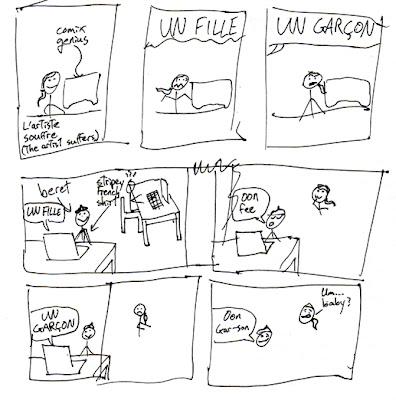
Lucy & I collaborated on a comic!  I wrote it based on a true story about our internet French lessons.  Guess which version is mine and which is hers.

Thursday, February 21, 2008

Input vs. Output


Work is kind of slow these days, so I'm taking some corporate training classes online, like "Influencing Without Authority" and "Critical Thinking," and the best thing about them is that they have all sorts of great pictures to illustrate their points.


I know this is basically a case of the smug, cynical employee making fun of the corporate videos to prove that he's too cool for The Man's brainwash material, but they shouldn't make it so easy on me with pictures like this:


The training I've been going through at work reflects a trend appearing in other parts of my life lately - specifically, a trend in my input to output ratio. 

For example, workplace training can be considered input: the trainee receives information from an outside source.  Workplace duties, for most people, can be considered output: in my case, I produce documents, tweak and install software, troubleshoot the system, etc.  Lately, circumstances have dictated that I've had to spend more time doing the former than the latter.


Creativity can also be thought of as an input/output system.  Reading is input, and lately I've been on a tear, finishing Hunter S. Thompson's posthumous oral biography, the entire Scott Pilgrim series of graphic novels, and Alan Cooper's assessment of why tech products suck all in a relatively short amount of time (for me).  However, this is my first written blog post (output) in over a month, while before that I had a streak of several posts no more than two weeks apart.

My guitar/piano practice (output) has been on the decline as well, or at least not as satisfying, and the ideas that I do get around to recording never seem very good to me the next day.  I envy my friends who seem to be better disciplined in this area; I'd expect that they make practice a priority, whereas I can never pick up my guitar until I've replied to all my emails, screwed around for a while, checked all my daily websites for updates... and by then it's usually almost time for this 9-to-5er to get ready for bed.  On the other hand, I've been listening to a shitload of podcasts (input) - Kevin Smith's SModcast and Dan Savage's Savage Lovecast are two of my favorites - and trying to pay better attention to what I like and don't like about the music I listen to, hoping that it can help me improve the stuff I'm recording.

Even my alcohol input seems to be on the rise lately.  But that's not so bad - until you input too much and are forced to output it.


There's no formula for the correct balance of input vs. output in everyone's lives.  In many cases, input facilitates an increase or improvement in output.  It's been fun to talk about this idea with people to sort out which activities are input and which are output - like if you go to the movies with your friends, watching the movie is input and discussing & deconstructing the movie afterwards is output.  This concept has been floating around my brain for a while now and I'm interested to hear other people's input (or output) on it.


Thursday, January 10, 2008

Three cheers for the metric system!

Last night I was reading a book called Time and the Art of Living, which is a collection of meditations on time by an English professor named Robert Grudin.  I'm in the middle of a chapter in which Grudin is advocating metric time, which would be a system built upon our base-10 numbering system, and I have to admit that it's making a lot of sense.  24 hours in a day?  60 minutes in an hour?  Why make time that difficult to manage or calculate?  And what's up with this clumsy system of 7-day weeks, and months that not only don't line up evenly with those weeks but are also of different lengths?


It turns out that metric time (or decimal time) was actually adopted by the French during the Revolution at the same time as metric spatial measurement.  According to the website A Guide To Metric Time, there were:

  • 10 days in a metric week (called a dekade)
  • 10 metric hours in a day
  • 100 metric minutes in a metric hour
  • 100 metric seconds in a metric minute
Grudin suggests in his book that each year could be made up of 12 months of 30 days (3 weeks) each, with a vacation period of 5 days (6 in a leap year) to account for the remainder.  We could make up 3 new days of the week, and the days of the week would always fall on the same dates every month.

Unfortunately (in my opinion), the French ditched metric time in 1805 after a glorious 12-year run.


(This is a picture of an actual metric clock from around the time of the Revolution.)

As long as I'm complaining, what's up with this crazy language of ours?  The vowels are pronounced differently based on context, there are all sorts of conjugations specific to certain words, I can't end a sentence with a preposition for some reason... wouldn't it just be easier if we all learned Esperanto, the language created by L. L. Zamenhof in the 1880's?  Esperanto was designed to simplify pronunciation, spelling, and conjugation, in the hopes that it would become a universal auxiliary language.  The characters in the 28-letter alphabet (based on the Roman alphabet) are always pronounced the same way, and conjugations are universal - for example, singular nouns always end in -o, plural nouns always end in -oj, present tense verbs always end in -as, etc.  The global Esperanto community is estimated at as many as 2 million people, with somewhere between 200 and 2,000 native speakers.  There are movies, magazines, even college courses conducted entirely in Esperanto.


(Esperanto's flag, worn as a lapel pin to help speakers identify each other)

Esperanto is built well and is supposedly easy to learn, especially for those who already speak a major European language, but over a century after its inception Esperanto still suffers from a lack of exposure, and English is currently far more universal than it appears Esperanto will ever be.

Both metric time and Esperanto are great ideas that could never get a foothold.  I don't plan on learning Esperanto anytime soon, but I would love to own a metric timepiece.  How cool is that clock from the Revolution?!

Technorati Tags    

Tuesday, November 13, 2007

Stories of the Road, issue 26: An in-flight bibliography

*NOTE: This is my first post to Blogger, but I have blogged on MySpace for quite a while. To dig through my MySpace blogging history, go here.


After a thoroughly enjoyable month of employment based in the Chicago suburbs, I'm back on the road this week, writing this blog on my 4-1/2 hour flight to LAX. Fortunately, I brought along some excellent reading material that's making me forget that I have felt my legs atrophy significantly over the course of the flight - looks like my traveler's fortitude has suffered from the respite. The nice thing about evening flights is that you can play the cloud shapes game with the patches of light from the towns below; I just passed a crop of lights that looked like a giant beetle.


Malcolm Gladwell has finally returned from a hiatus of several months with a great article on how the FBI's long-revered criminal profiling methodology is really just pseudo-scientific cold reading. He spent his hiatus working on his next book, and although I have no idea what it's about I'm getting antsy just thinking that more Gladwell goodness will soon be rolling off of a printing press somewhere, rife with counterintuitive wisdom backed by rock solid case studies. Try to stay with me here, but there's something similar about Malcolm Gladwell's work and the web services/products that Google provides. In both cases, the simplicity of their packaging makes the content more intuitive. It reminds me of the way the word "elegant" is used in the context of computer programming to describe a solution that implies a harmony of simplicity and robustness. Leonardo da Vinci said that simplicity is the ultimate sophistication, and I think that idea is manifest in output such as Gladwell's Blink and Google's RSS feed manager Google Reader.

But I digress.


I'm also slowly working my way through Naomi Klein's No Logo, which is an examination of the state of advertising, branding and marketing at the end of the 20th century. The big picture so far isn't too surprising - Guess what? Corporations are EVERYWHERE! - but the cited examples of out-of-control branding still strike your gut as foul, such as Fashion Licensing of America's line of Ernest Hemingway furniture ("designed to capture the 'brand personality' of the late writer"), or Nike internally coining the term "bro-ing" to describe its process of borrowing style, attitude and imagery from black urban youth. She just wrapped up a chapter on how the Seattle grunge scene didn't really stand for anything but an aesthetic, making it perfect for brands to swoop in and co-opt. That section is followed with some well-worded passages about how being interested in something ironically is a vapid cop-out, which I LOVED reading because I feel like I've never really understood the "so bad it's good" theory.

* * * * * * *

I'm now in the cab on the way to the Beverly Hills Hilton, where a room awaits me. Let's see if I can still remember my hotel room arrival routine: open suitcase on second bed, put toiletries by the sink, iron and hang shirts... yes, yes, it's all coming back to me.

Lucy & I had a fabulous time this weekend seeing They Might Be Giants at The Vic, eating at our favorite Wicker Park restaurants, and falling asleep during two consecutive attempts to watch Ratatouille. We also had some heavy-duty conversations; it was good to get away from the catch-up we play over the phone every week, and to interact deeply with someone so close to me. Those experiences don't happen every day.