Showing posts with label language. Show all posts

Wednesday, September 10, 2008

Writing about writing

Hi, all.  About two weeks ago, my lungs turned into the La Brea tar pits, and I've been a wheezing bag of slime ever since.  Luckily, in between games of Super Mario Galaxy and meals of greasy breakfast foods, I've found a few interesting things to read.  Here are two pieces I'd recommend to anyone interested in dusting off the old quill and inkwell.

Through Merlin Mann's wonderful blog on 43folders.com, I found a short essay by Kurt Vonnegut entitled, "How to Write With Style."  The entire article is here and you can read it in 5 minutes if you don't get distracted - more difficult than it sounds while at your computer, I know - but I'll summarize it for the convenience of those short on time or up too late (like me).

  1. Find a subject you care about
  2. Do not ramble, though
  3. Keep it simple
  4. Have guts to cut
  5. Sound like yourself
  6. Say what you mean
  7. Pity the readers

My favorite line from the piece is the last paragraph for point 5:

I myself find that I trust my own writing most, and others seem to trust it most, too, when I sound most like a person from Indianapolis, which is what I am. What alternatives do I have? The one most vehemently recommended by teachers has no doubt been pressed on you, as well: to write like cultivated Englishmen of a century or more ago.

For those with lengthier attention spans, take a look at The Elements of Style, by William Strunk, Jr. and E.B. White.  (Coincidentally, I was about halfway through this book when I read the Vonnegut essay, which recommends Elements of Style at the end.)  The advice is more mechanical & dry: omit needless words, use the active voice, keep related words together, etc.  These guidelines are linked by the book's central theme: writing should be clear and vigorous.  Strunk best expresses this idea with four words, elegantly practicing what he preaches: every word must tell.  There's also a great analogy in there about how there are no unnecessary lines in a drawing, so why should there be unnecessary words in a book; unfortunately, my copy of the book is 1,700 miles away right now (Stories of the Road returns soon!) so I can't quote it exactly.

* * * * * * *
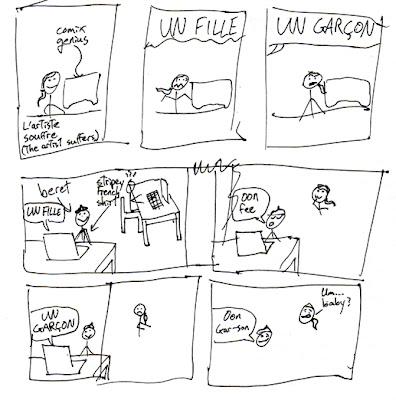
Lucy & I collaborated on a comic!  I wrote it based on a true story about our internet French lessons.  Guess which version is mine and which is hers.
Tuesday, April 22, 2008

I'm so sick of this, I could literally kill someone

Yesterday's Dinosaur Comics addressed our society's widespread inability to use the word "literally" correctly.  Today, in an interview on Countdown with Keith Olbermann, Hillary Clinton described America as being "literally over the oil barrel" with regard to our energy policy. Et tu, Hillary?

One easy way to make the world a better place is never to misuse the word "literally" again.  If that proves too difficult, you can always play video games for charity.  What?  Huh??  Yeah!

FreeRice is a vocab-building game that will donate 20 grains of rice through the UN World Food Program every time you can pick the correct definition for a word.  The difficulty level moves up and down based on your answers, and there's no limit to how much rice you can donate.  Philanthropic logophiles rejoice!

What's that you say?  Big words are for bookworms and college professors and Noah Webster?  Perhaps you should try FreePoverty instead.  The game lists off cities and landmarks from around the world and you have to mark their locations on a world map.  The more accurate you are, the more clean water is donated to people living in extreme poverty.  Do you know where the country of Moldova is?  What about Namibia?  Learn how bad your geography is with FreePoverty!

* * * * * * *

For all interested parties: about 15 pictures from our last party can be viewed in the below slideshow.  Everything labeled "vs. pinata" is a video; click on the thumbnails to see them.

Thursday, January 10, 2008

Three cheers for the metric system!

Last night I was reading a book called Time and the Art of Living, which is a collection of meditations on time by an English professor named Robert Grudin.  I'm in the middle of a chapter in which Grudin is advocating metric time, which would be a system built upon our base-10 numbering system, and I have to admit that it's making a lot of sense.  24 hours in a day?  60 minutes in an hour?  Why make time that difficult to manage or calculate?  And what's up with this clumsy system of 7-day weeks, and months that not only don't line up evenly with those weeks but are also of different lengths?


It turns out that metric time (or decimal time) was actually adopted by the French during the Revolution at the same time as metric spatial measurement.  According to the website A Guide To Metric Time, there were:

  • 10 days in a metric week (called a dekade)
  • 10 metric hours in a day
  • 100 metric minutes in a metric hour
  • 100 metric seconds in a metric minute
Grudin suggests in his book that each year could be made up of 12 months of 30 days (3 weeks) each, with a vacation period of 5 days (6 in a leap year) to account for the remainder.  We could make up 3 new days of the week, and the days of the week would always fall on the same dates every month.

Unfortunately (in my opinion), the French ditched metric time in 1805 after a glorious 12-year run.


(This is a picture of an actual metric clock from around the time of the Revolution.)

As long as I'm complaining, what's up with this crazy language of ours?  The vowels are pronounced differently based on context, there are all sorts of conjugations specific to certain words, I can't end a sentence with a preposition for some reason... wouldn't it just be easier if we all learned Esperanto, the language created by L. L. Zamenhof in the 1880's?  Esperanto was designed to simplify pronunciation, spelling, and conjugation, in the hopes that it would become a universal auxiliary language.  The characters in the 28-letter alphabet (based on the Roman alphabet) are always pronounced the same way, and conjugations are universal - for example, singular nouns always end in -o, plural nouns always end in -oj, present tense verbs always end in -as, etc.  The global Esperanto community is estimated at as many as 2 million people, with somewhere between 200 and 2,000 native speakers.  There are movies, magazines, even college courses conducted entirely in Esperanto.


(Esperanto's flag, worn as a lapel pin to help speakers identify each other)

Esperanto is built well and is supposedly easy to learn, especially for those who already speak a major European language, but over a century after its inception Esperanto still suffers from a lack of exposure, and English is currently far more universal than it appears Esperanto will ever be.

Both metric time and Esperanto are great ideas that could never get a foothold.  I don't plan on learning Esperanto anytime soon, but I would love to own a metric timepiece.  How cool is that clock from the Revolution?!

Technorati Tags